
STANDARDIZED DATA ASSETS

Control Your Data

When client histories are scattered across different platforms, they exist in proprietary shapes that your firm does not control. Work Aloha normalizes these unstructured inputs into a single, standardized format—turning temporary digital streams into permanent data assets.
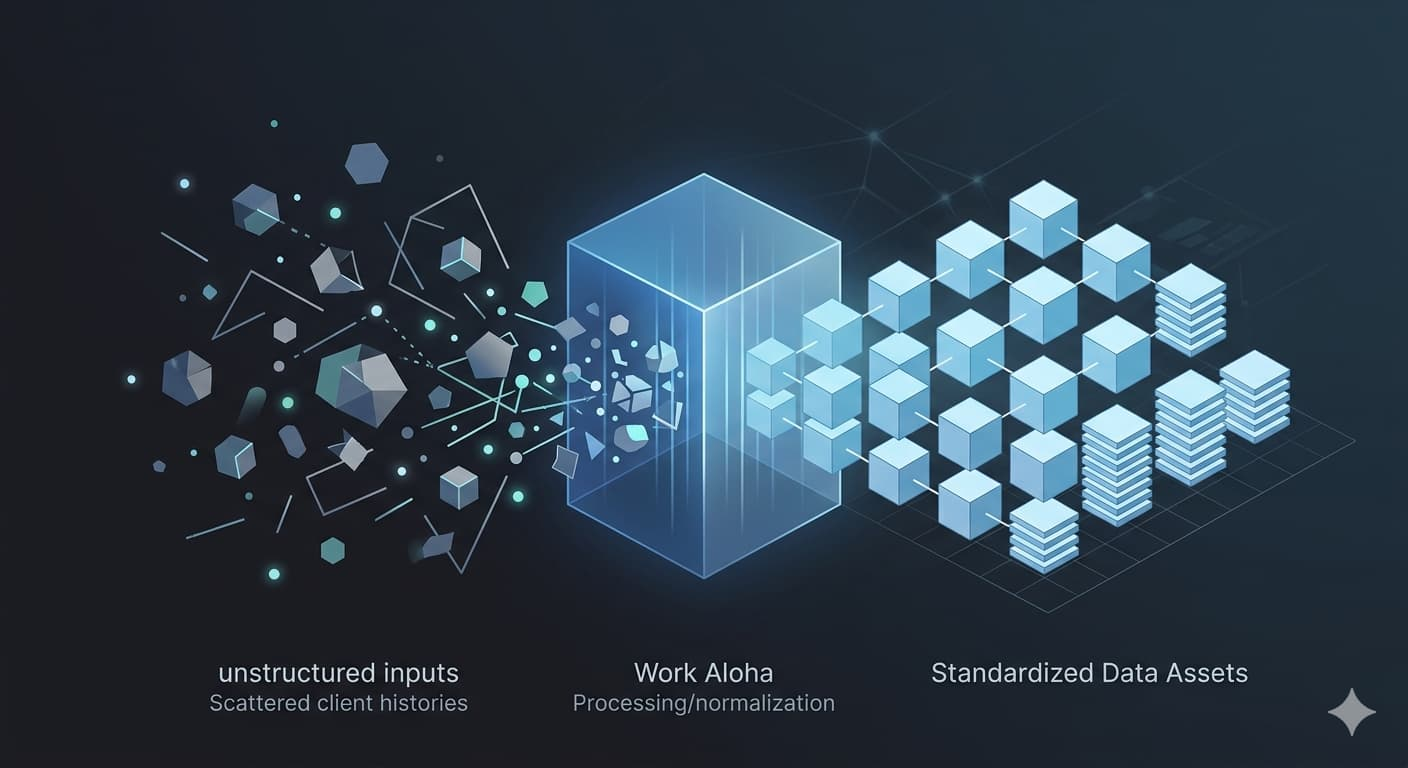
standardized-data-assets

ESTABLISHING STRUCTURAL CRITERIA

Predictable data architecture

We maintain strict governance over data formats, complementing technical integrations, and archival protocols. Every decision is guided by the principle that your organization must own and control its digital property unconditionally, independent of any software vendor's business continuity.

background_placeholder

WORK ALOHA STANDARD

Engineering structural clarity

Work Aloha began when recognizing that firms were losing control of their own data due to proprietary third-party vendor formats. We built normalization protocols that convert unstructured inputs into permanent, standardized assets. Today, we provide enterprise-grade data architecture frameworks that protect organizations from ownership risk, compliance gaps, and operational inefficiency.

A MESSAGE FROM THE FOUNDER
“Standardization isn't about limiting flexibility—it's about establishing permanent ownership of your data so technology serves your firm instead of controlling it.”
STANDARDIZING DATA ASSETS

Structural Unity for Fragmented Records

True data independence requires a predictable architecture. Discover how standardizing your records bridges compliance gaps, mitigates data ownership risks, and ensures your infrastructure remains resilient with vendor changes or platform failures.

Operational Friction

Teams lose billable hours manually translating, converting, and searching across incompatible system formats that stifle productivity and increase operational costs.

Data Ownership Risk

Data locked in vendor-specific structures leaves your organization entirely dependent on continuous software subscriptions to access your own history and records.

Compliance Vulnerability

Non-standardized records creates gaps in history, leaving your organization exposed during routine compliance verification cycles and compounding the probability of compliance failures.

Integration Complexity

Custom vendor-specific formats and data structures multiply technical debt as each new system requires unique integration work, slowing cross-platform utility and increasing total cost of ownership.
GAIN ABSOLUTE STRUCTURAL CLARITY

Download our technical whitepaper on Standardized Data Assets.

Access our technical whitepaper to discover how standardizing your firm's records eliminates operational friction, bridges compliance vulnerabilities, and transforms fragmented data into permanent digital assets.

Transform fragmented records into structured data property

data-architecture